
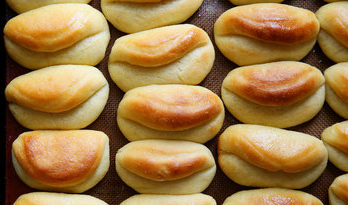
If they look familiar, that’s because everyone else in the world calls them Parker House rolls.
We have served these at every Thanksgiving dinner in our family for more than 50 years … and there are never, ever enough no matter how many batches you make. The first time Carla made them on her own, she didn’t realize the yeast should be proofed; she just made the dough the way she saw Grammy make it year after year. As a result, her rolls turned out just like Grammy’s – kind of dense and lumpen with little bits of potato chunks, and delicious. Laura and Ania’s method is below, and makes much airier and lighter rolls, which we love just as much.
- 1 cup mashed potatoes
- 1 cup milk, heated to 110-120 degrees
- ⅓ cup water
- ⅔ cup softened butter; or ⅓ cup softened butter and ⅓ cup shortening
- ½ scant cup sugar
- 2 eggs, well beaten
- 1 package yeast
- 1 teaspoon salt
- 6 cups flour
- 1-2 sticks melted salted butter (this is one of the very few times we insist on salted butter)
It doesn’t matter what kind of mashed potatoes you use. Make them from scratch, use the instant flakes, or the refrigerated prepared kind. We generally make them from scratch so we can control the salt and fat content as needed to make the rolls (and having tiny lumps of potato in the rolls is delicious), but use what is easiest for you.
Proof yeast in ⅓ cup water and 1 cup of flour. Heat milk; then add butter and sugar, then mix in potatoes. When the mix is lukewarm, add eggs and proofed yeast; beat well. Cover with towel and let rest until mix turns bubbly. Add salt and just enough flour to make a moderately stiff dough. Cover with towel and let rise until doubled. Roll dough out on floured surface to about ⅓-inch thick. Don’t worry if the dough looks like it has tiny lumps or bubbles in it – this is normal. Cut into 2- to 3-inch rounds.
(Note: this next step is drippy and messy, so make sure you’ve covered your countertops or have plenty of paper towels handy to clean up spills.) Dip both sides of the rounds in melted butter, then fold into half-circle shapes. Place on baking sheet; make sure the rolls are not touching. Cover rolls with a kitchen towel and let rise until doubled.
Preheat oven to 400 degrees. Bake rolls about 10-12 minutes or until lightly browned. Potato rolls freeze very well in plastic bags, and will thaw at room temperature in less than 15 minutes. However, the rolls taste best when they are served warm.
Grammy’s recipe called for scalding the milk. You don’t need to do that – although old recipes often call for it, most of them were probably created before Louis Pasteur got cracking in his lab. Cooks using raw milk from their own cows knew as early as the Middle Ages that they had to boil milk before it was safe to use; commercial pasteurization processes have already heated the milk to kill off all the nasty bacteria. What scalding does do is evaporate surface water and coagulate the milk proteins and fat in a skin on the surface. When you need coagulated milk – say, for chlodnik soup – that’s fine. But coagulation isn’t critical to yeast batters. Just heat the milk to the temperature necessary to proof the yeast, and the potato rolls will turn out fine.
from our Grammy, Lucille Lacaff Marshall
 Around Our Table