
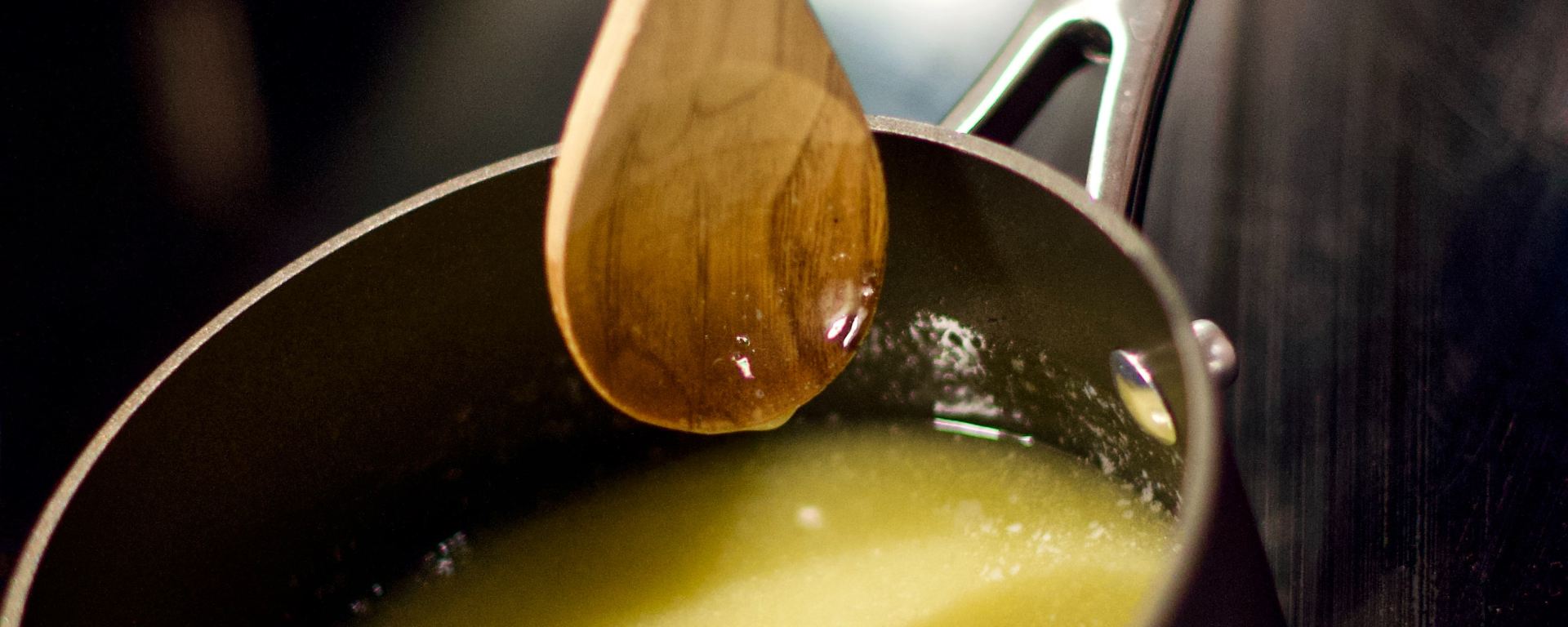
Family legend says that our paternal grandmother – “Mamcik,” which means “mother” in Polish – made her beef stock by boiling a full sirloin roast until it liquefied. We don’t go quite that far; despite legend, making soup stock isn’t complicated. You need:
- Roasted beef bones for beef stock, or veal bones for veal stock
- Roasted poultry bones for chicken or turkey stock
- Cooked fish scraps and bones for fish stock
- Water
- Onion, roughly chopped
- Celery, roughly chopped
- Carrots, roughly chopped
- Seasoning of your choice
Roasted bones add a depth and richness to stock that you can’t get if you toss in, say, a bunch of raw fish fillets. If you aren’t in the habit of buying huge cuts of meat with bones (who is?) find a nearby butcher shop that will sell you bones and roast them in the oven yourself (at 350 degrees, on a big baking sheet) until they’re nicely browned. Put the bones, and leftover meat or skin, into a deep stockpot and cover with water.
Add onion, celery and carrots – the traditional ingredients of mirepoix. For soup instead of stock, you do want to start with the mirepoix: sauté those three vegetables in butter or olive oil until caramelized and very tender to make a rich and flavorful base for your soup (or sauce). But for stock, you can just toss them into the water, skipping the sauté.
Finally, add the seasoning of your choice – whether it’s bonnes herbes or Lawry’s salt, season the stock according to how you think you are going to use it. Just remember that if you seasoned the original meat during roasting, those flavors will also show up in the finished stock. It’s easy to oversalt!
Cover the stock and allow it to cook down, on medium heat, for at least four hours. If you are fussy, take the lid off once in a while and skim off the weird-looking bubbles on top.
At the end of the cooking time, strain it through a fine sieve into another container. Then put the stock in the refrigerator to cool overnight.
Don’t ever allow your stock – or any hot food – to cool slowly on the stovetop or counter. You will create a welcoming host for all kinds of nasty bacteria which can make you, your family and friends very sick. The goal is to keep food hot while it’s cooking and being served, then cool it down as rapidly as possible, because, like Goldilocks, bacteria don’t like environments that are too hot or too cold. The essential part of that goal is to limit the time the food spends in the temperature “danger zone” of 40-140 degrees Fahrenheit, because that’s where bacteria like to flourish and party. As one of our chef friends says, you want parties to be memorable for the right reasons, not the wrong ones.
Always transfer hot food into smaller containers and put the smaller containers into the refrigerator immediately. No, this will not raise the interior temperature of your refrigerator to dangerous levels. A well-behaved fridge knows it is designed to work harder for a short time until the thermostat drops back to where it is supposed to be. You will find online lots of recommendations to, instead, cool hot food in an ice bath before refrigerating it. But for heaven’s sake, unless you work in a restaurant or have a McMansion-sized kitchen with a commercial ice machine at the ready, you’re not going to have (a) the counter space, (b) enough ice, or (c) enough time in a normal day to clean up the resulting mess.
The day after you’ve made the stock, make at least one ice cube tray of stock cubes. Put these in the freezer, and when they are solid, put them into a zippered freezer bag. Whenever you need to boost the flavor of a dish you are cooking, grab a cube or two and toss it in the pan. We also invested in a couple of silicone freezer trays that hold one-cup portions of liquids, which are wicked handy when we decide we want soup for dinner and need a quick stock base.
If you are really lucky, your stock will have turned into jelly during its night in the fridge; you can look forward to many happy silky soups, sauces and gravies over the next few months. If it didn’t, that’s OK – it will still taste better than anything that comes in a soup can.
Whenever you have leftover carrots or celery, give them a rough chop and put them in freezer bags for your next stockpot. A lot of cookbook writers and “save the food” writers insist on saving vegetable scrapings and discarded meat to toss in the stockpot. This makes no sense to us; what kind of flavor are you going to get from a couple of freezer bags’ worth of beet scrapings? Mamcik had the right idea – to get delicious results, start with top-quality ingredients. You don’t have to sacrifice an expensive roast, and you should never throw away food that you can freeze and use later, but don’t expect to make a magnificent stock out of compost scraps, either.
Photo by Dan Dennis on Unsplash
 Around Our Table