
Because both our grandmother Mamcik and Great-Aunt Nela made this recipe (it also appears in Nela’s Cookbook, and I’ve copied her citrus topping here), it most likely came from the kitchen of their childhood home, Ilgovo, in Lithuania. I keep telling myself I should ask Nela’s children (along with whether they know what happened to four of their seven siblings who survived childhood – we only know of three who survived World War II), but then life takes over and another year has gone by and I still haven’t asked them.
Finally, in the last few years, I’ve seen dozens of recipes for mazourka or mazurka pop up on the internet, including ones from the Food Network and Food.com. The posts attribute these bars to Poland, to Belarus, and to Russia, among others, and some of them have streusel on top, some say the base is supposed to be flaky, and some turn out more like cakes. Suffice it to say this treat is Eastern European, and the end result of our version is more like lemon bars but with different toppings. It doesn’t matter which topping you pick – all of them are delicious.
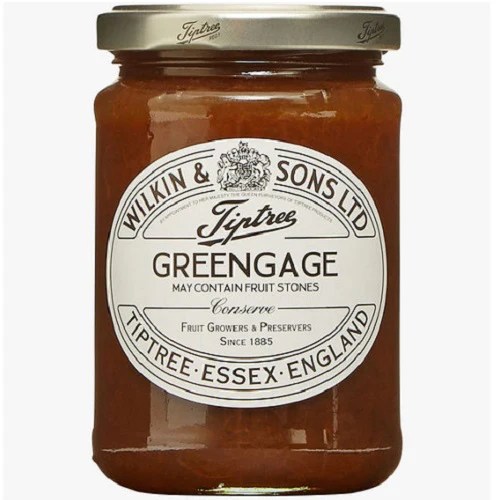
Oh, and the reason there’s a picture of green gage plums conserve here? We used to make this only with canned green gage plums imported from Poland. But the last source of canned plums we know of went out of business about ten years ago; however, there is a company called British Food Supplies that exports green gage plum preserves to the U.S. If you’re in California, you might be lucky enough to find fresh ones at a farmer’s market.
The base: Kruche Ciasto
Pronounced “crew-hay CHAW-stow,” it’s the shortbread-like cookie base for mazourka.
- 2 sticks butter
- 1 egg
- 1 cup sugar
- 3 scant cups flour
Preheat oven to 350 degrees. Mix ingredients with hands – do not overmix or the base will become tough. Press dough into jelly roll or half sheet pan. Bake at 350 degrees for about 15-25 minutes until very lightly browned.
Fruit Topping
You can make mazourka with any kind of crushed or cut-up fruit, as long as you adjust the sugar to taste. Green gage plums tend to be much sweeter than other kinds of tree fruit, so tread lightly.
- 2-4 cups of crushed or cut fruit
- Sugar to taste
Remove pits or stones and crush fruit with hands (or place cut fruit); spread over kruche ciasto as soon as you’ve pulled it from the oven. No need to cool it first. Sprinkle generously with sugar. Put pan under broiler until sugar caramelizes and bubbles, but do not let it burn.
Tanouchka
- 1 cup cream
- 1 cup sugar
- 1 inch of vanilla bean, seeds scraped out
Combine all ingredients, including scraped bean pod, into saucepan with high sides. Cook over medium heat, stirring constantly, until temperature reaches 235 degrees (soft ball stage). Pour over kruche ciasto while hot; allow to cool completely before cutting.
Don’t make the topping too thick, as it will not set firmly. Your goal is a thickness halfway between a glaze and a layer of icing. If you have leftovers, pour those into glass or ceramic bowls to cool, and store in the refrigerator; you can eat them by the spoonful while watching Netflix. If you get really lucky, the surface will crystallize a little and you will get delicious crunchy bits to enjoy.
Citrus Topping
- 2 oranges
- 1 lemon
- 1 ½ cups sugar
Wash fruit well and cut into chunks, leaving rind and skin on (but remove seeds). Process to pulp, and cook with sugar over low heat until thick – about 30 minutes. Pour over kruche ciasto while still hot; allow to cool before cutting.
You can also put this one under a broiler for a few minutes to caramelize the top if you like, but again, don’t burn it.
 Around Our Table